Finalist · ASUS UGen AI League 2026 local-first
Audio description that fits the silences.
GapCaster drafts a timed, spoken description track for finished films. It finds the gaps between dialogue, writes to the exact time available, speaks and measures every line, rewrites what does not fit, and keeps a human describer in control. It runs on one local GPU — the video never leaves the machine.
Listen to the difference
Both clips are the same 2 min 20 s excerpt. One has no description; the other has GapCaster's narration fitted into the pauses. The script and timing are published with the sample.
What a blind viewer hears today
Dialogue and score, with no information about the picture. Most Mandarin-language titles never get a described track at all.
Transcript of the excerpt
Dialogue and sound only — no description is present in this version.
The same scene, described
17 lines, each fitted to its gap. A describer can approve, edit or reject every line before it is mixed.
Description script (17 lines)
[00:00:11.350] Multiple rocket engines ignite, shooting bright white and pink flames downward.
[00:00:18.420] A bright beam of light shoots up from the industrial site.
[00:00:45.550] A caption: Forty years later.
[00:00:53.950] A caption: Simulation ready. Two people work at a cluttered electronics bench.
[00:01:02.650] A caption: Tears of Steel.
[00:01:09.920] A foggy city skyline blends old rooftops with industrial machinery.
[00:01:14.780] A person lies motionless on the floor near two lit candles.
[00:01:19.380] A headline: Roboticist creates killer robots.
[00:01:22.810] The sniper aims his rifle.
[00:01:25.070] A circular scope frames a large, stationary mechanical structure with turrets in the fog.
[00:01:32.420] The sniper peers through the rifle scope.
[00:01:35.420] The airship hovers above the city.
[00:01:38.210] The old man lies prone, eyes closed, while the sniper aims.
[00:01:42.420] A dark, armed airship hovers over red-roofed buildings, emitting smoke and bright light.
[00:01:52.070] The sniper aims his rifle through a scope.
[00:01:58.950] The old man raises his head and gestures, while the sniper aims in the background.
[00:02:13.250] The old man looks down.
Open the describer review page for this run — timeline, every line with its evidence, fit attempts and flags. Plain script.
What has been measured
Results are from the published runs in the repository. The 140 s excerpt was also the development clip, so it is in-sample; the full-film numbers use the same code. Known misses are listed, not hidden.
| Measure | 2:20 excerpt | Full film (12:14) |
|---|---|---|
| Shots · dialogue spans · usable silences | 25 · 9 · 9 | 130 · 63 · 44 |
| Lines that fit their silence | 17 / 17 | 70 / 71 |
| First draft · speed ladder · rewrite | 15 · 2 · 0 | 60 · 2 · 5 |
| Narration over detected dialogue | 0.0 s | 0.0 s |
| Narration over official subtitle cues | 0.4 s | 5.8 s (mostly cue tails) |
| Verifier · obvious planted errors caught | 17 / 17 | 40 / 40 |
| Verifier · in-film word/character swaps caught | 15 / 17 | 34 / 40 |
| Processing time per content minute | 125 s | 137 s |
| Peak model memory | 33.2 GB | 34 GB |
Measured 8B lean profile: 13.7 GB peak, 50 s per content minute, 19/19 lines fitted — inspect the run and its trade-offs. Mandarin mode (review page) now runs at 13.8 GB (15/15 lines fitted). Known limitations: a short line can finish before a later shot appears (10 of 70 lines in the full film); the text gate forces one rewrite; timings were measured on a laptop also running other work. Full list in the README.
Six stages, all local
No frontier API, no cloud upload, no account. The only network use is downloading open-weight models once.
Map the silences
Whisper word timestamps and Silero VAD independently mark dialogue. A silence is usable from 0.25 s after a line to 0.30 s before the next; long silences split at shot cuts.
Read the shots
A vision-language model returns JSON facts per shot: who, where, action, on-screen text, the key visual fact, confidence. A cast sheet keeps names consistent.
Write to budget
Narration is drafted for a word budget of the window at 2.6 words/s (3–18 words). Unread on-screen text is queued; credits and web addresses are filtered.
Speak and measure
Kokoro TTS speaks each line; its real duration is measured. If it overflows, the line is tried at 1.08× and 1.15×, then rewritten with the exact overflow, up to three rounds.
Gate and verify
Deterministic rules block camera language, speculation and first person. A verifier checks every claim against the shot facts on screen while the line plays; no verdict is flagged.
Human approves
The describer sees each line with its frame, facts, attempts and flags, then approves, edits or rejects. Export mixes only approved lines and re-times edited ones.
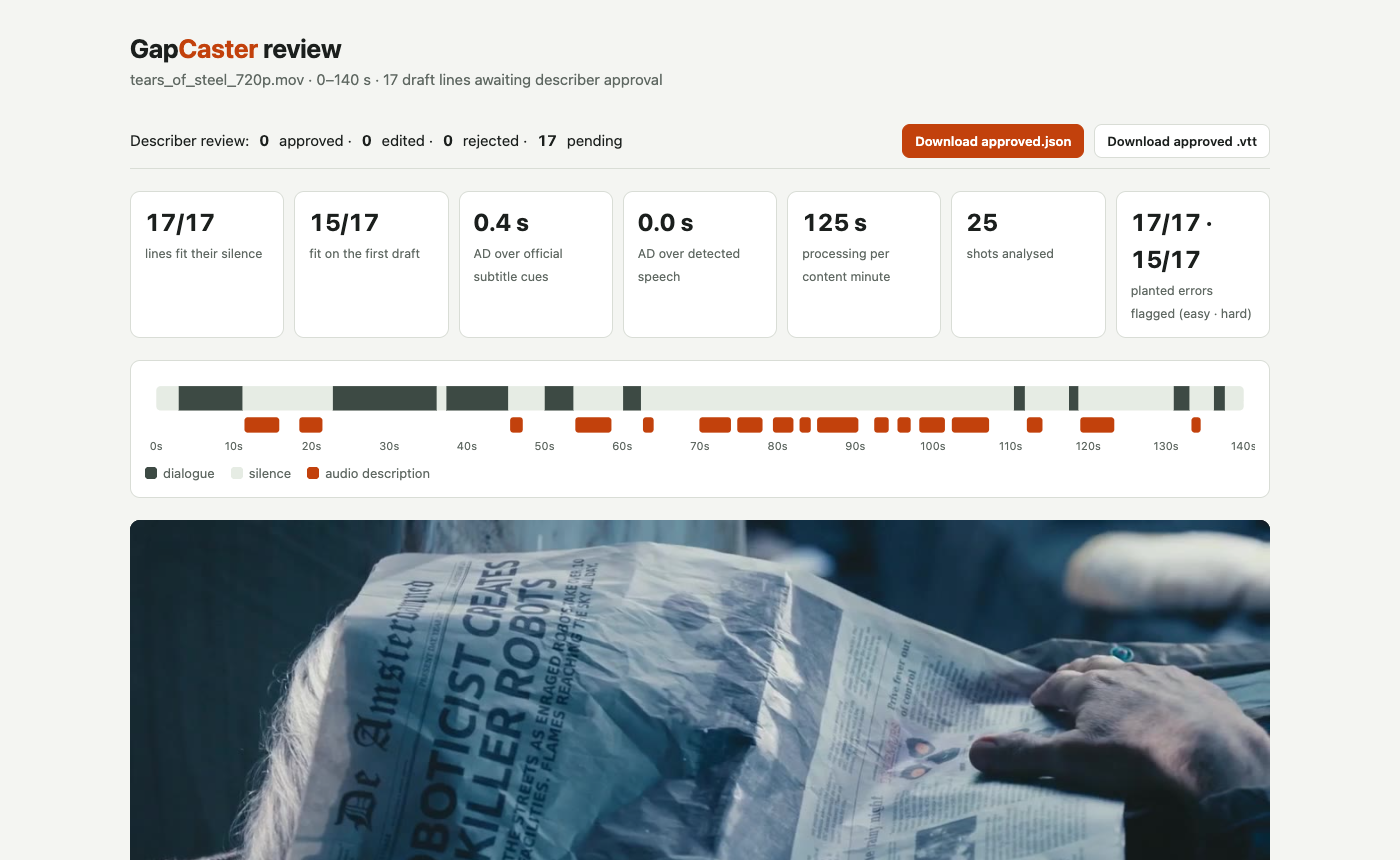
AD is a timing craft
Most tools generate text and assume it will fit. Audio description has to fit a specific interval between two lines of dialogue without covering either. GapCaster treats that as a control loop: speak, measure, adjust, rewrite. Its output includes the timing evidence, so a human can check the machine instead of trusting it.
Built to be Human-Scale
The Mozilla Foundation Incubator's Human-Scale AI cohort asks for technology that is small, intentional and tailored. This is how GapCaster answers each.
Small.
One local acceleration device, open-weight models, no frontier API. Stage I: Qwen3.8-27B (8-bit) for shot facts, Whisper large-v3-turbo for dialogue, Kokoro-82M for speech; 33–34 GB peak. A Human-Scale 8B edition (GapCaster Small) runs in English and Mandarin at 13.7–13.8 GB peak on one laptop.
Intentional.
The film never leaves the machine. No accounts, no telemetry, no cloud calls. Every line carries the facts it came from, its drafts, fit attempts, style flags and verifier verdict. The describer can audit and reject; only approved lines are mixed. Code is MIT; model licences are recorded.
Tailored.
Designed for blind and low-vision viewers and the describers who serve them, around the constraint that defines AD: the gap. The next step is Mandarin and Taiwanese AD, co-designed with local listeners and describers — because a good line sounds different in each language and culture.
Status and next steps
Listener pilot: does it actually help?
We are testing the described excerpt with blind and low-vision listeners: 15 minutes, remote and anonymous, no recording, two versions of the same scene. The study is run by the developer, not by Mozilla. If you would like to take part — or you are a describer who wants to try the review page — start here.