Human-Scale edition · ≤10B open models · English & Mandarin · local-only
Audio description that fits the silences.
GapCaster Small drafts a timed, spoken audio-description track on one laptop. It finds the silences between dialogue, writes a line for each, speaks and measures it, shortens what overflows, and shows the visual evidence behind every line so a human describer approves what is released. Nothing leaves the machine.
zh-TW voice)Listen to the difference — on a Taiwanese Mandarin narrative drama
Held-out out-of-sample test: 0:00–2:20 of Grandma's Words (《阿嬤的話》, National United University / dir. Huang Tzu-Yen, CC BY 3.0), where brief Taiwanese Mandarin dialogue gives way to 86 seconds of silent visual discovery (a grandma's White Castle cookie tin containing hospital medication packs and an embossed Baishatun Mazu temple amulet). Below: original vs. GapCaster Small's Qwen3.5-9B draft spoken in local Taiwanese Mandarin (zh-TW) — alongside our English 8B player above and our Young Coffee Story documentary test.
86 seconds of silent plot twist
From 0:54 onward there is almost no dialogue — only footsteps, a drawer opening, pill packs inside a butter-cookie tin, and a red temple amulet. Without AD, the entire narrative twist happens in silence. In Taiwan, all terrestrial TV stations aired only 269.75 hours of AD in 2025 (53 newly produced hours on public TV).
16 / 16 lines fitted · 0 factual hallucinations · 13.1 GB peak
Upgrading from late-fusion Qwen3-VL-8B to early-fusion Qwen3.5-9B eliminated 8B's US-prior mistakes (calling the White Castle cookie tin "beef patties" and assuming cookies inside instead of medication packs and the red Mazu amulet), while catching 15/15 easy & 15/15 subtle planted errors. Inspect all 16 lines on the Grandma's Words review page.
Taiwanese Mandarin description script — Grandma's Words (16 lines)
[00:00:00.300] 穿灰衫戴金十字架者立沙灘。
[00:00:04.550] 灰天海灘浪打濕沙。
[00:00:10.220] 黑髮灰衫男看右再望下。
[00:00:15.310] 灰衫男胸前白字與金十字架項鍊。
[00:00:36.410] 灰衫男觸碰項鍊再望遠處。
[00:00:41.790] 灰衫男靜立海灘,海平線遠處有船。
[00:00:54.450] 灰衫男開啟木門。
[00:01:02.600] 灰衫男的手放在大型深色長方物體頂端。
[00:01:09.530] 雙手放於深色木桌邊緣。
[00:01:13.450] 木櫃內有「白城堡」字樣的圓鐵盒。
[00:01:35.140] 雙手掰開圓鐵盒蓋子。
[00:01:41.850] 一手持圓鐵盒,一手拿深色藥排。
[00:01:46.840] 手拿出白包,露出紅繩綁的紅方塊。
[00:01:57.030] 白衣男子低頭,手中捧著紅方塊。
[00:02:02.620] 手捧紅牌寫白拱沙天屯宮媽祖。
[00:02:12.670] 白衣男子側臉凝望,手放鍵盤滑鼠。
Inspect every describer review page (frames, rejected drafts, timings, verifier flags): Grandma's Words 9B review (zh-TW) (script) · Young Coffee doc 8B review (script) · Tears of Steel Mandarin 8B review · Tears of Steel English 8B review · 27B reference review.
What has been measured on small models (8B vs. 9B ≤10B)
Measured on one Apple M5 Max laptop across Tears of Steel (in-sample EN/zh), Grandma's Words (held-out Taiwanese Mandarin drama, head-to-head Qwen3-VL-8B vs. Qwen3.5-9B), and Young Coffee Story (held-out Taiwanese documentary). Known misses are published alongside wins.
| Measure (0:00–2:20) | 8B, EN (ToS) | 8B, zh (Grandma's Words) | 9B, zh (Grandma's Words) | 8B, zh (Young Coffee) | 27B ref (EN, 2:20 / 12:14) |
|---|---|---|---|---|---|
| Lines that fit their silence | 19 / 19 | 17 / 18 (1 held) | 16 / 16 | 13 / 13 | 17 / 17 · 70 / 71 |
| Narration over detected speech | 0.0 s | 0.0 s | 0.0 s | 0.0 s | 0.0 s · 0.0 s |
| Narration over official subtitle cues | 0.6 s (cue tails) | n/a | n/a | n/a (open-captioned) | 0.4 s · 5.8 s |
| Verifier · obvious planted errors caught | 18 / 19 | 13 / 15 | 15 / 15 | 12 / 13 | 17 / 17 · 40 / 40 |
| Verifier · subtle in-film swaps caught | 13 / 19 (verb 0/5) | 12 / 15 (nbr) | 15 / 15 (nbr) | 12 / 13 (nbr) | 15 / 17 · 34 / 40 |
| Verifier flags on unmodified lines | 2 / 19 | 0 / 17 | 5 / 16 (shot-cut timing / paraphrase) | 3 / 13 (dissolve leads) | 1 / 17 · — |
| Midpoint frame check (acc · minor · wrong) | — | 12 · 4 · 1 | 12 · 4 · 0 | 6 · 5 · 2 | 13 · 4 · 0 · — |
| Processing per content minute | 50 s | 38 s | 43.5 s | 39 s | 125 s · 137 s |
| Peak model memory | 13.7 GB | 14.0 GB | 13.1 GB | 13.6 GB | 33.2 GB · 34 GB |
Honest trade-off: staying strictly within ≤10B parameters, moving from Qwen3-VL-8B to early-fusion Qwen3.5-9B lowers peak memory to 13.1 GB, achieves 16/16 silence fit, catches 15/15 subtle planted swaps, and eliminates 8B's cookie-tin hallucination on Grandma's Words (0 wrong lines; 4 minor shirt-carryover or right-to-left character-order notes, 3 of which the verifier itself flagged for the human describer). Full known-limitations list in the README.
Six stages, all local — plus a browser studio for describers
No frontier API, no cloud upload, no account. Four of the six stages use deterministic code or tiny speech models under 1B; only visual facts, short-line drafting and checking call Qwen3.5-9B (or Qwen3-VL-8B).
Map the silences
Whisper large-v3-turbo (0.8B) word timestamps and Silero VAD independently mark dialogue. Silences keep 0.25 s lead and 0.30 s tail; long silences split at PySceneDetect shot cuts.
Read the shots
Qwen3.5-9B (or Qwen3-VL-8B) returns JSON facts per shot: who, where, action, on-screen text, key visual fact and confidence. A describer-written cast sheet controls how characters are named.
Write to budget
Drafts are budgeted at 2.6 words/s in English or 4.0 characters/s in Traditional Chinese. Unread story text is queued; production credits and URLs are filtered.
Speak and measure
Open-weight Qwen3-TTS-1.7B (Taiwanese Mandarin) or Kokoro-82M (English) speaks each draft and measures its real duration. Overflows try 1.08× and 1.15× speed, then rewrite against the exact overflow.
Gate and verify
Deterministic English and Mandarin AD rules block camera language, speculation and first person. A grounded verifier checks each claim against the shots on screen while it plays.
Describer Studio
gapcaster web opens a local-only (127.0.0.1) studio where describers audit frames and provenance, approve/edit/reject lines, and re-mix only approved lines in one click.
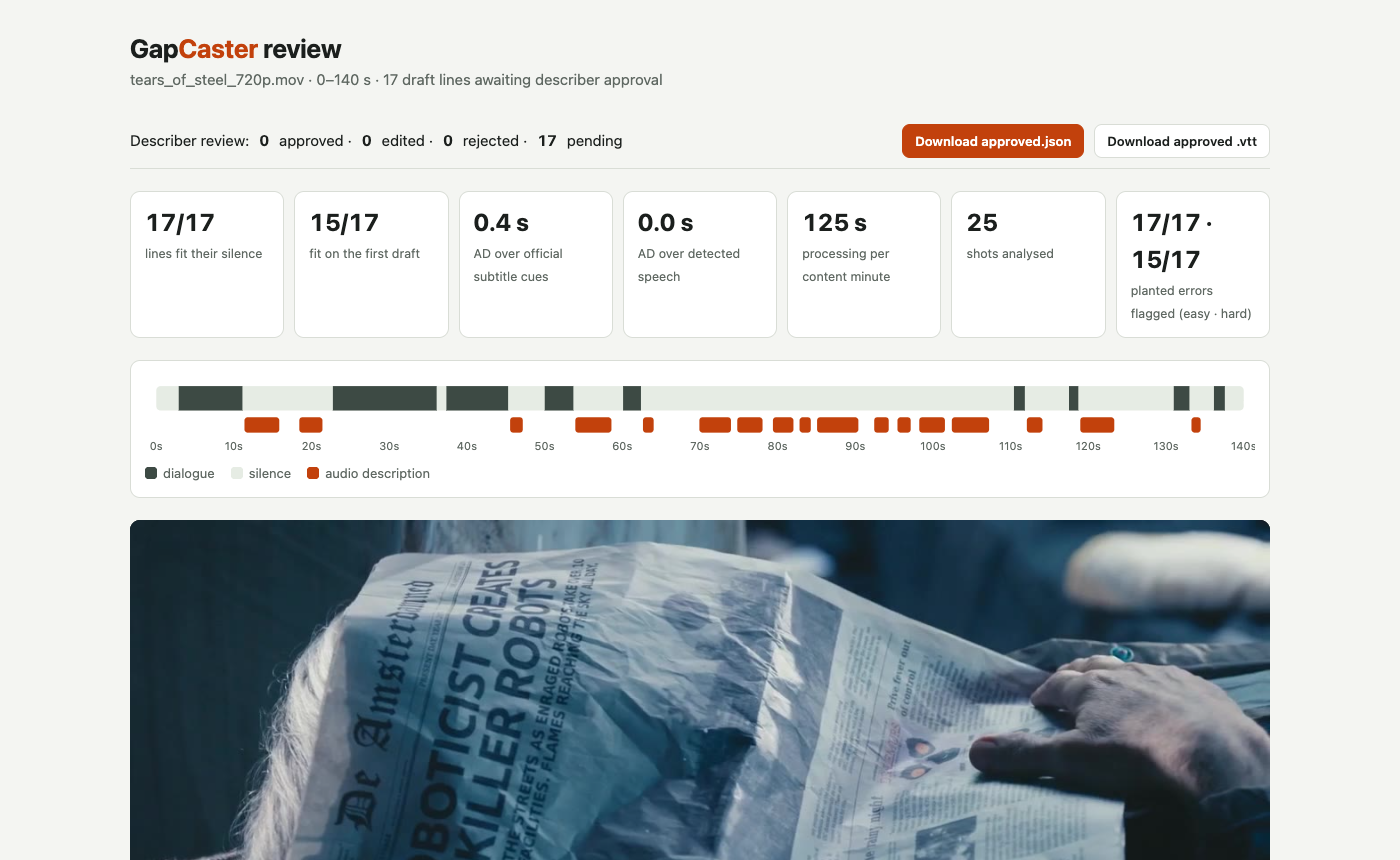
Measure, don't guess
Audio description is a narrow craft task with a physical constraint: spoken duration must fit the silence between two lines of dialogue. By turning Kokoro-82M into a closed-loop duration sensor and enforcing AD style rules deterministically, an 8B model on one laptop hits 100% silence fit without calling a frontier API.
Small. Intentional. Tailored.
Small.
All core models are ≤10B open weights: Qwen3.5-9B / Qwen3-VL-8B, Whisper large-v3-turbo (0.8B), Silero VAD, Qwen3-TTS-1.7B (Mandarin) and Kokoro-82M (English) — 13.1–13.7 GB peak on one laptop, ~38–50 s per minute of video, zero cloud compute. Small studios and schools often handle unreleased or licensed footage that cannot be uploaded, on tiny budgets.
Intentional.
Footage, transcripts and drafts stay on 127.0.0.1: no accounts, no telemetry, no API calls. Every line keeps full JSON provenance, the describer's cast sheet governs naming, and export mixes only human-approved lines. Plain-text AD rules are open for describers and blind listeners to govern.
Tailored.
Built specifically around dialogue silences, professional AD guidelines, and a non-CLI browser review workflow. Tailored for Taiwan's AD gap with Traditional Chinese text tracks, character-rate budgets, Mandarin style rules, and an accessible screen-reader listening study.
Listener pilot: does it actually help?
We are testing the Mandarin and English described excerpts with blind and low-vision listeners and audio describers: 15 minutes, remote and anonymous, screen-reader friendly, no audio recording, two versions of the same scene.